
Four years, three times through
History is not one subject among many — it is the frame every other subject hangs on. Every child travels the same four-year cycle in the same order, at their own stage — and siblings four years apart move through the same era in the same year, so their read-alouds, timeline work, and dinner-table talk all point at one period of the past. The cycle repeats at rising depth: Grammar (K–4) meets the era as story, Logic (5–8) as argument, Rhetoric (9–12) as judgment.
Year 1 — Ancients
Earliest peoples to about AD 500. Gilgamesh and Aesop, Greek myth and the Odyssey, pharaohs and lawgivers — the era as story, argument, and finally judgment.
Year 2 — Medieval & Renaissance
500 to 1600. Chant and cathedrals, troubadours and polyphony, the long middle of the story — and the rebirth that ends it.
Year 3 — Early Modern
1600 to 1850. The laboratory and the printing press grow up together; revolutions in science, in art, and in how people govern themselves.
Year 4 — Modern
1850 to today. The machine age: factories and railways, world wars and new nations — the world your students were born into, studied whole.
History — the Spine
Every subject hangs on the year’s era.
History units run by civilization and era, in chronological order. Every unit carries narrated lessons, at least one primary source — a text from the era itself — timeline work, and a map habit. Your student never meets a date without a place and a person attached.
Writing lives inside History, not beside it: because every writing task is drawn from the history lesson, Writing is a sub-block under the History block. Grammar-stage children narrate and take dictation; Logic-stage students outline the history readings and write their first summaries; the outline of a history chapter is the writing lesson.
See it in Studio Mode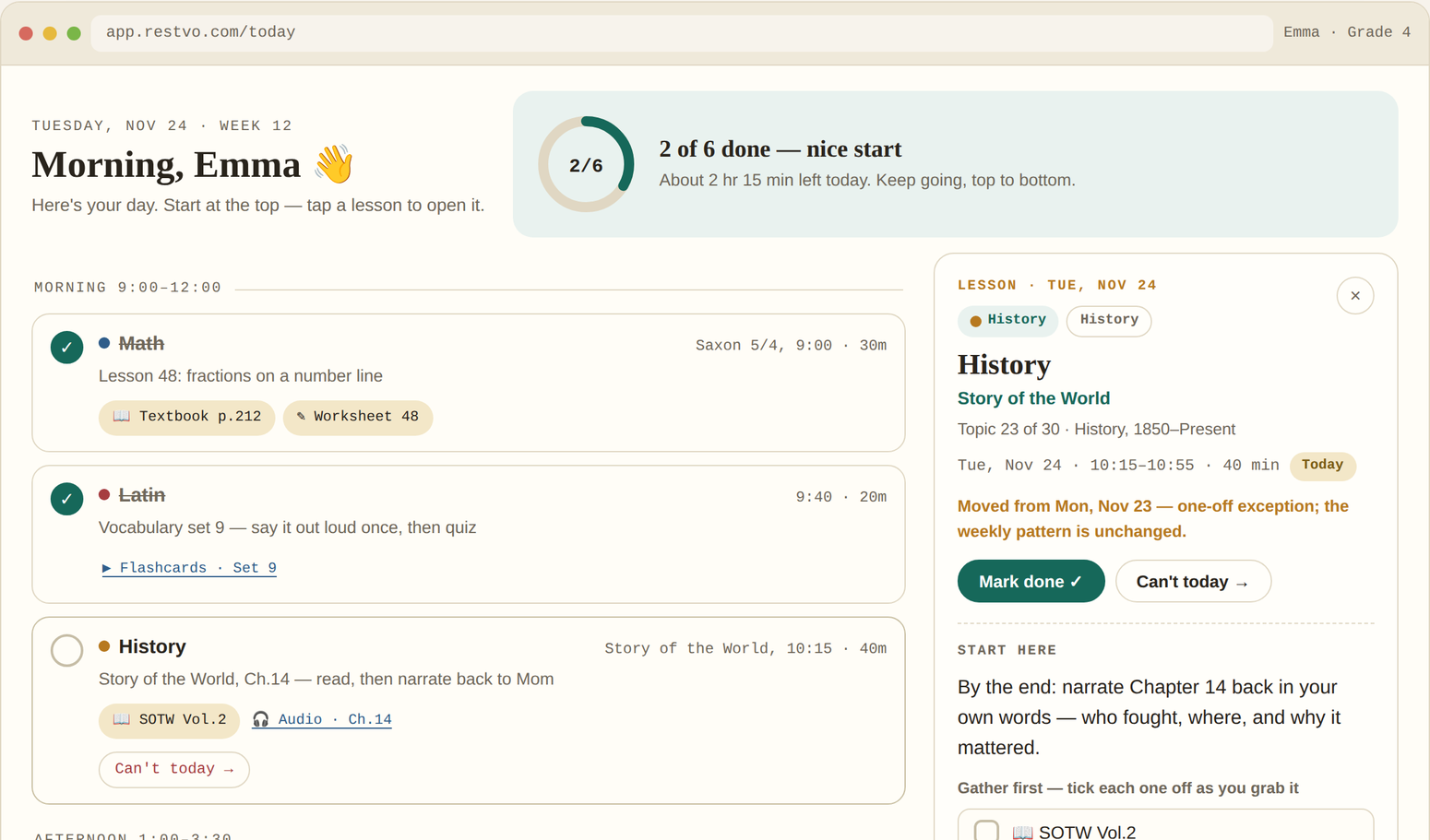

English
Great Books in the morning. Language arts after lunch.
English runs in two slots, both fed by the era. The morning slot — Great Books reading, Monday, Wednesday, and Friday — is the era’s own great books and great retellings, read sustained and discussed, not sampled. Year 1 reads Gilgamesh, Aesop, Greek myth, and the Odyssey. The list is the curriculum; everything else practices on it.
The afternoon slot is the mechanics — vocabulary from the era’s root languages, systematic grammar whose practice sentences are drawn from the year’s history, spelling and copywork on real era texts. By the Rhetoric stage the drills fall away and English fuses with History into Great Books: whole originals, deep research into a topic in the year’s history, and two or three theses written and defended across the school year.
Science follows the era, too
The classical rotation keys Science to the cycle year, in the order the sciences themselves matured. Every unit pairs a free online video, a hands-on experiment with household materials, and a library encyclopedia to borrow. Music appreciation listens to the era once a week — chant and modes in Year 1, polyphony, Baroque, Classical, and Romantic as the years advance — and Art pairs a four-year drawing progression (line, shape, shading, perspective, figure) with the art of the era under study.
Year 1 · Life Science
The ancients were observers of living things. Classification, habitats, the body — observation first, exactly as the era’s own natural philosophers worked.
Year 2 · Earth & Space
Medieval astronomy and geology: the turning sky, maps and compasses, rocks and the shape of the earth.
Year 3 · Chemistry
The early-modern laboratory: elements, reactions, and the careful notebook. Household-material experiments in every unit.
Year 4 · Physics
The modern machine age: motion, energy, electricity — the science underneath the world of Year 4’s history.
Math
Your math curriculum. Our calendar.
Math is deliberately not part of the catalog. It is a skills ladder your family already follows in a curriculum of your choice — Math Mammoth, Math-U-See, Art of Problem Solving, or another you name — and Restvo does not presume to replace it.
Instead, a term’s Math is a schedule-only placeholder block: pick the curriculum and your child’s grade level once, and the block sits on school days (9:00–10:30 by default), every session simply labelled “Math Mammoth, Grade 5.” Marking work done and recording grades attach to the block — for grading purposes, the placeholder is the Math course. You work your own books at your own pace inside it; Restvo tracks the time and the grades, never the page numbers.

Inside Every Lesson
Lessons that teach, not just assign.
Open any lesson in the catalog and you will find a full lesson body, in a collapsed “Lesson” section the student expands: the teaching itself, with worked examples; exercises the student answers right in the app; and the source excerpt the exercises work on, printed in full — a Fordham Sourcebooks text, a Gutenberg classic, a passage from Hyde’s Practical Lessons for grammar.
Grading is point-based, per lesson: each exercise carries points, and the grade is the points earned against the points possible. The standard answers live in the lesson too — visible to you, the educator, never to the student — and automatic grading that compares a student’s answers against them is a paid feature, for families who want the machine to do the first pass.
How lessons are builtHonest about what is still coming
Foreign Language is a placeholder for now — Latin first, because it belongs with Year 1: the language of Rome, of law, and of half of English vocabulary — with Greek after it. The catalog grows year by year and stage by stage, and every addition passes a human review gate in the Curriculum Editor before it publishes. Nothing in Restvo Classical publishes itself.
The whole catalog, free in Studio Mode
Open Studio Mode, preview any curriculum, and add it to your term. Restvo Classical is free for every family, forever.
Browse Curricula